MUTEX index funds: many assets, one position
13 November 2026
How MUTEX index funds pick, weigh and rebalance a basket of stocks, ETFs and crypto for you, and how to build and run your own around any theme.
Owning the market used to mean owning a dozen positions: buying each one, sizing each one, and coming back every month to trim what ran ahead and top up what fell behind. A MUTEX index fund does all of that for you. You buy one fund with USDC, and it holds a whole basket of tokenized US stocks, ETFs and crypto, picked and weighted by a written rule, and put back to its weights on a fixed calendar. One position on your account, and nothing to rebalance by hand.
And you are not limited to our funds. With the index builder, any theme you believe in, a sector, a niche inside it, a type of asset or several themes at once, becomes a live fund in three steps. MUTEX runs it for you, anyone can buy into it, and you earn its fee.
This post walks through how it works, end to end: what you own, how a fund chooses its holdings, how it rebalances itself, how to build and run your own, and what happens to your money from the moment you deposit.
Why hold an index
- Breadth in one click. Our Core 20 fund holds twenty of the largest companies and crypto assets in a single position. You would need twenty orders to build it yourself, and twenty more every time it changes.
- Stocks and crypto in one basket. A fund can hold NVIDIA, Microsoft and Bitcoin side by side, bought with the same USDC and shown as one line in your portfolio.
- Discipline without effort. The rule decides, not a mood. Winners are trimmed back to their weight, laggards are topped up, and assets that no longer qualify leave the fund.
- Your idea, as a fund. If no fund matches your view, build one: choose the assets or the Categories it tracks, how it weighs them and how often it rebalances, and it runs itself from there.
- Everything in the open. Each fund’s page shows its rule, its current holdings and weights, its price history, a backtest and every fee, before you put in a dollar.
What you are buying
A MUTEX index fund is a pool of real tokens held in the fund’s own vault on Solana. You hold units of the fund, and each unit is an equal share of everything in the vault. The price of a unit, the NAV per unit, is set once a day from the value of the holdings.
So the arithmetic is simple. If a window prices a fund at 1.25 USDC a unit, a 500 USDC deposit buys 400 units. If the holdings rise 10% by the time you sell, so does each unit, before fees. Your units live on your MUTEX account: you buy them from your Funding balance and sell them back to it. There is no token to send and no leg-by-leg trading on your side.
How a fund chooses what to hold
Every fund follows a rule, and the rule is printed on its page. It answers two questions: which assets, and how much of each. A rule can pick the largest assets by market cap, the ones with the smallest fall from their high, the largest in each sector, or a hand-picked list. It then weights them by size, equally, at fixed percentages, or by size with a tilt toward the names furthest below their high. Most rules also cap any one asset, so no single name can dominate the fund.
Here is Core 20 as set at its November rebalance. The rule takes the 20 largest stocks and crypto assets by market cap, weights them by size, and caps each at 10%.
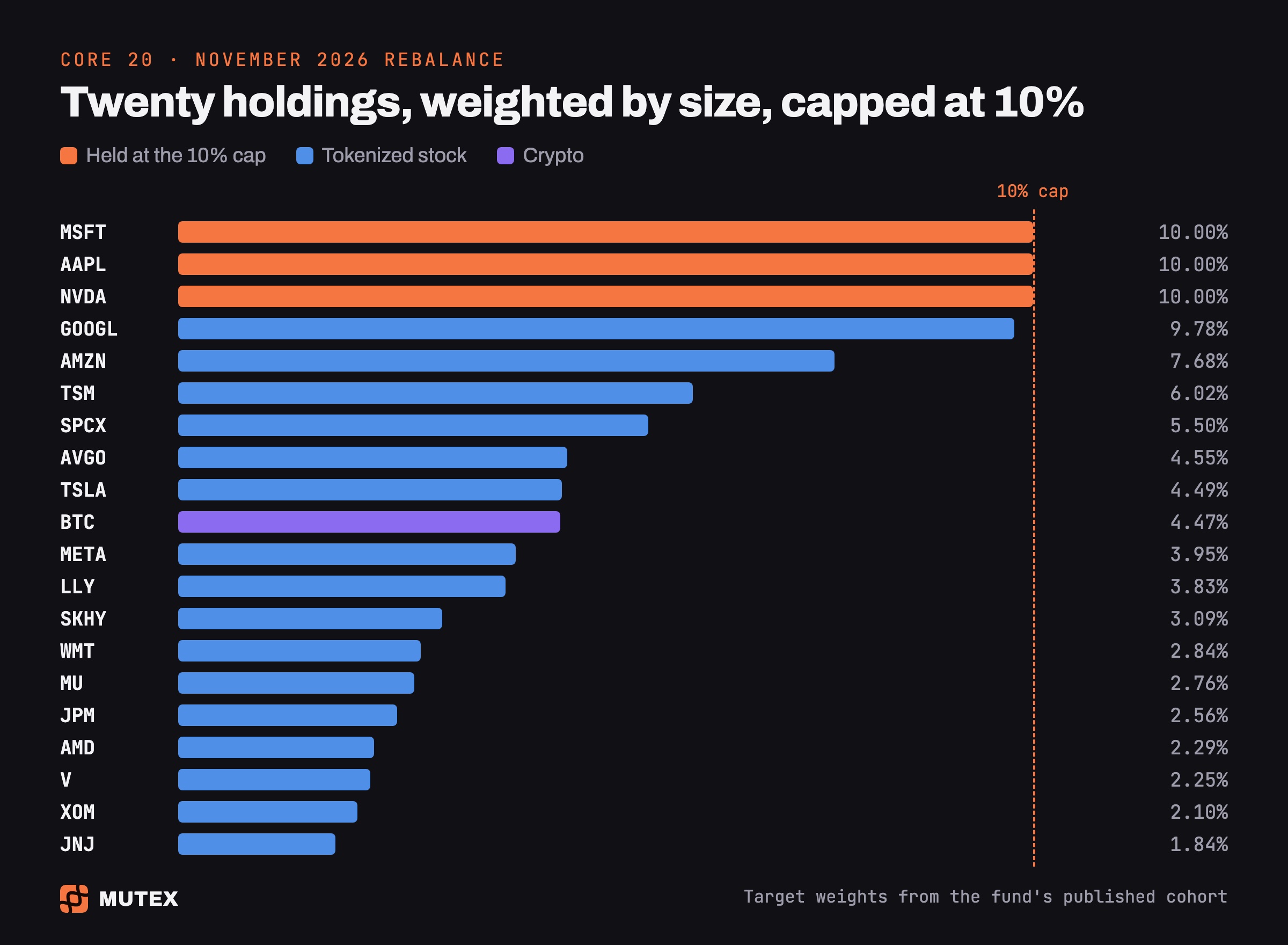
The cap is doing real work here. On size alone, Apple and NVIDIA would each be about 13% of the fund. The cap holds both, and Microsoft too, at 10%, and spreads what is left over across the other seventeen in proportion to their size. That is why Alphabet comes in at 9.78% rather than the roughly 9% its size alone would give it. You get the market’s leaders without betting the fund on two of them.
Core 20 is one of several house funds. Leaders holds the three largest stocks. Focus takes the five of the 50 largest with the smallest fall from their high. Sectors takes the largest name in each sector. AI Leaders holds twenty hand-picked AI companies at 5% each. The full list and each rule are on the index funds page.
How rebalancing happens on its own
Prices never stand still, so a basket set to its weights today is off them by next month. What ran up becomes a bigger slice of the fund, and what fell becomes a smaller one. Left alone, a fund slowly turns into a bet on whatever rose most. Rebalancing is the cure, and on MUTEX it is automatic.
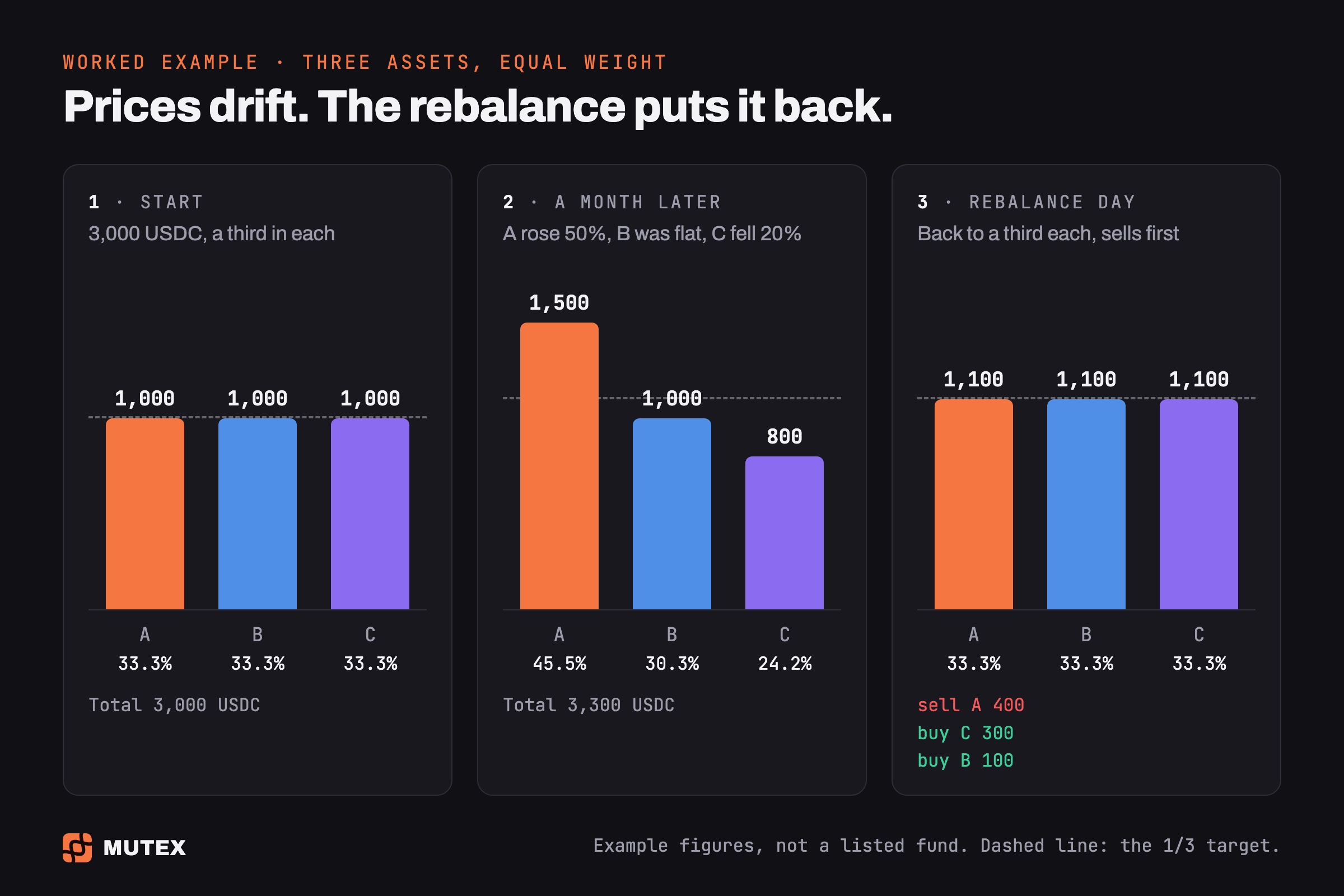
Every fund has a rebalance calendar, chosen when it is made: monthly, quarterly, twice a year or once a year. Most house funds rebalance monthly. On a rebalance day the rule runs again on fresh month-end data. It may choose new holdings, and any asset that no longer qualifies is sold in full. Then every holding is traded back to its target weight, sells first, so the sales fund the buys. In the example above, the fund sells 400 USDC of A and uses it to buy C and B, and all three are back at a third each.
Between rebalances, your money does the work
On the days in between, a fund never trades on price moves alone. That would churn small funds on daily noise and pay fees for nothing. Instead, the money that comes in and goes out is pointed at the drift:
- New money buys what is furthest behind. Take the fund in step 2 above, at 1,500, 1,000 and 800, and someone deposits 300 USDC. The fund is now worth 3,600, so each asset should be 1,200. C is the furthest short, so all 300 goes to C. Nothing is sold, and A is not topped up any further.
- Withdrawals come out of what ran ahead. If instead someone withdraws 300 USDC, the fund sells it from A, the asset most over its weight, and leaves the laggards alone.
Either way the fund ends the day closer to its weights than it started, without a single extra trade. A trade too small to be worth a transaction, under 10 USDC currently, waits for a later window.
Build your own index
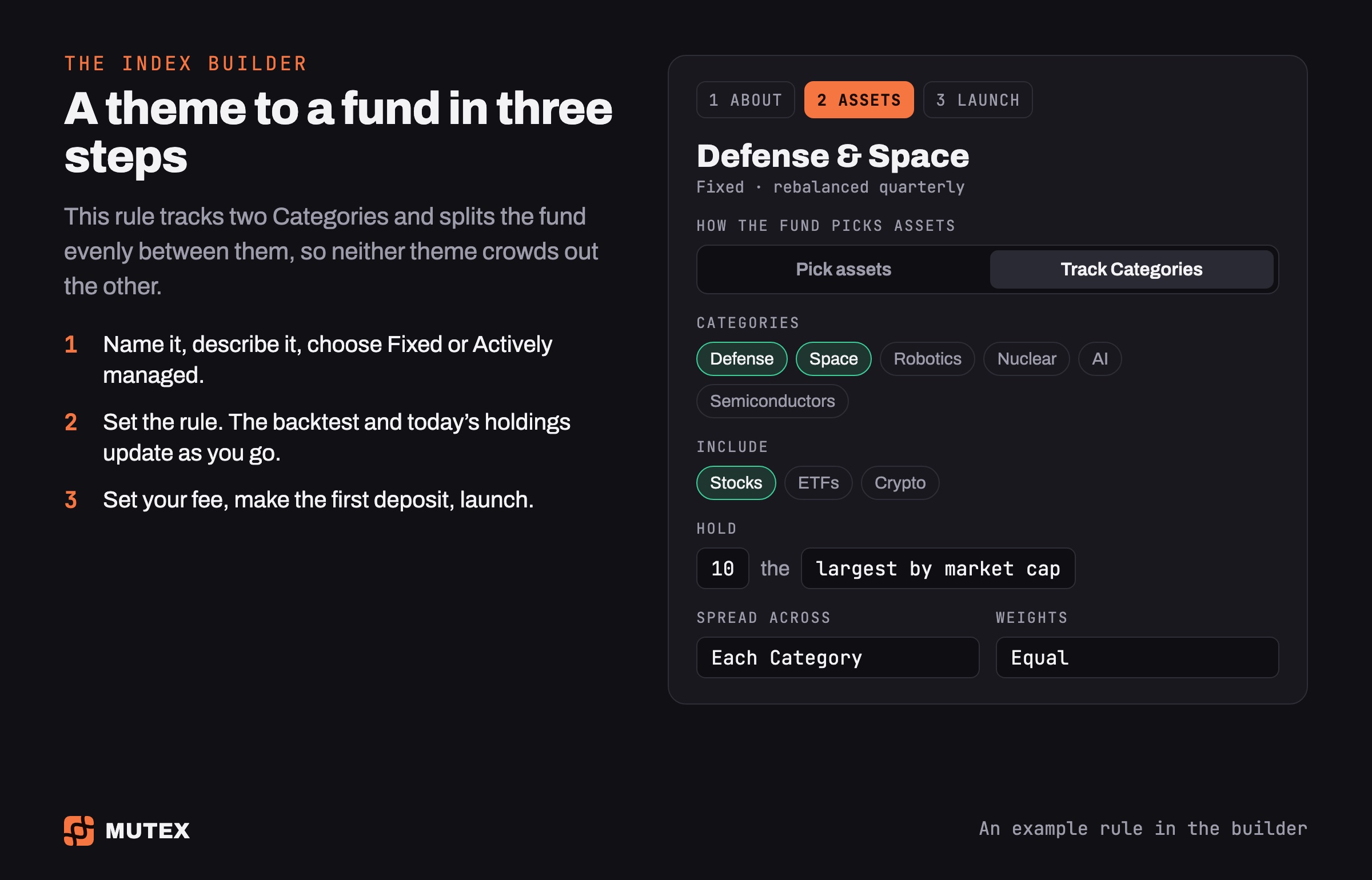
Everything above, the rule, the weights, the cap and the calendar, is yours to set. The index builder turns a theme into a fund in three steps, and from then on MUTEX runs it like any house fund: the daily windows, the trades and every rebalance.
Pick the assets, or track a Category
There are two ways to say what goes in, from hundreds of tokenized US stocks and ETFs and the largest crypto tokens:
- Pick assets. Choose up to 20 by hand, or start from a ready list: AI and chips, Big tech, Banks and cards, Health, or Steady names. Or pick as many as you like and let the fund hold only the top few of them at each rebalance.
- Track Categories. Choose one or more Categories and the fund holds assets in them. It looks again at every rebalance, so a new asset in the Category can join and one that no longer fits leaves. The fund keeps up with the theme without you lifting a finger.
Categories run from broad to narrow. At the top are sectors such as Technology, Energy, Finance, Healthcare, Industrials, Materials, Consumer and Crypto. Under them sit the niches: Semiconductors, AI infrastructure, Data centers, Defense, Space, Nuclear, Clean energy, Gold, DeFi, Layer 1 and many more. A niche counts under its parent, so one pick of Energy takes in the whole branch, while a pick of Nuclear holds only that.
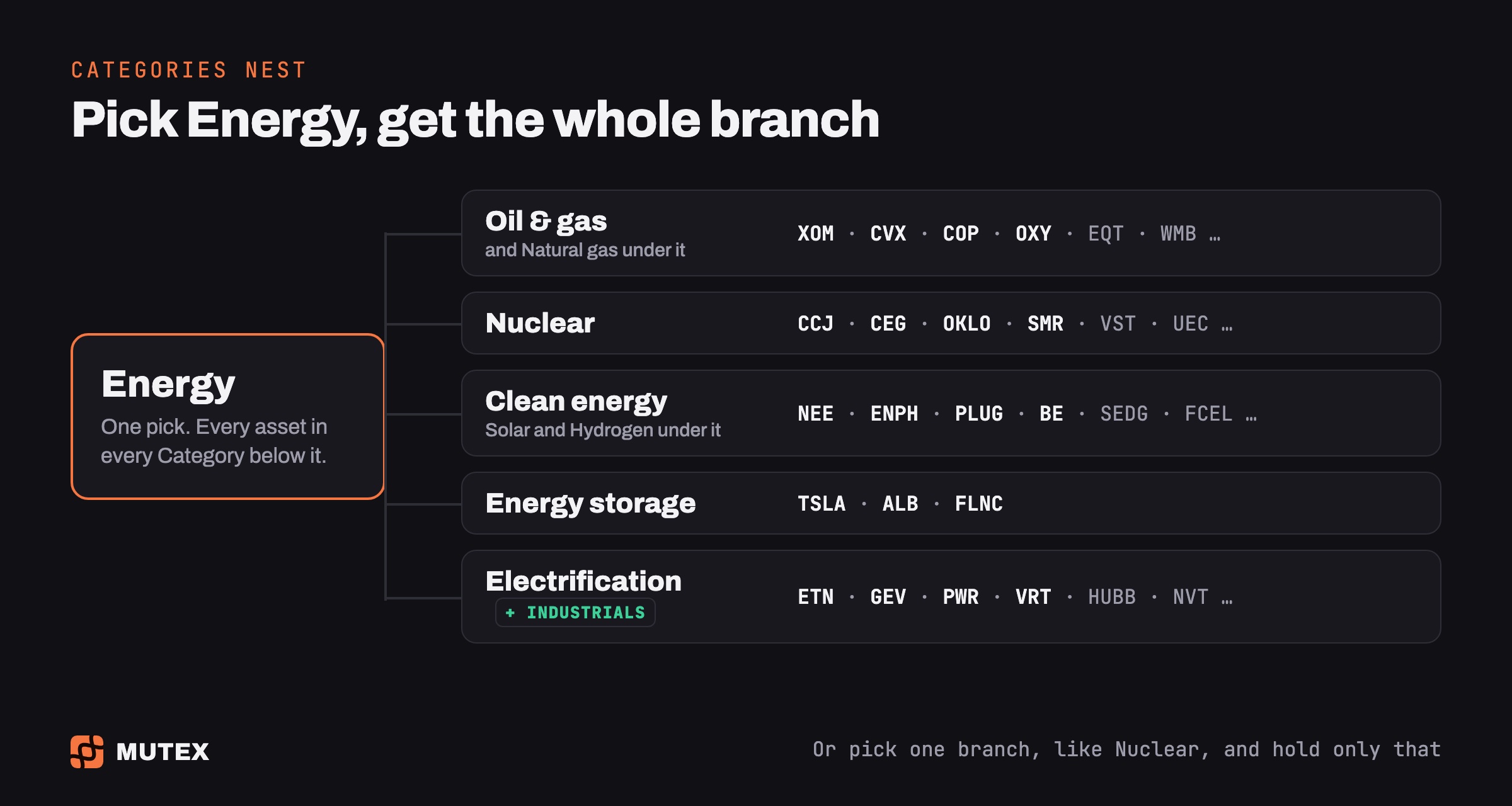
Choose several Categories to combine themes, and narrow any rule to stocks, ETFs, crypto or any mix of the three.
Shape the rule
- Hold: how many assets, up to 20, and which ones: the largest by market cap, the closest to their all-time high, or the furthest below it. You can first narrow the pool to the biggest 30, 50 or any number.
- Spread across: take a set number from each sector, industry or asset type, or take turns between your Categories so each theme gets about the same number of places.
- Weights: equal, by size, by size with a tilt toward what fell or what is near its high, or your own percent for each pick. Cap any one asset so no single name can run the fund.
- Rebalance: monthly, quarterly, twice a year or once a year.
See it before you launch
As you change the rule, the builder shows what the fund would hold today and at what weights, and draws a backtest of the rule beside it. A rule that would hold nothing says so while you set it. A first deposit too small to spread across every asset is refused before any money moves, with the amount that would work.
Rules you could build today
- Nuclear power: track Nuclear, stocks only, hold the 8 largest, by size, capped at 20% each, rebalanced quarterly.
- Defense and space, half each: track Defense and Space, stocks only, hold 10, spread across each Category, equal weights.
- A leader in every sector: track everything, stocks only, hold 10, one from each sector, by size, capped at 15% each.
- Energy near its highs: track Energy, choose from the 30 biggest, hold the 10 closest to their all-time high, equal weights.
- Crypto, against the trend: track Crypto, crypto only, hold the 5 furthest below their all-time high, equal weights, rebalanced monthly.
- Your conviction list: pick six names, set your own percent for each, and rebalance once a year.
Run it your way
When you create a fund you choose its type, and the type never changes. A fixed fund follows its rule for good, and its page shows how that rule would have performed. An actively managed fund lets you change its assets or its rule, at most once a day currently. Before you save, the editor shows exactly what the change will sell and buy, and how much of the fund turns over.
From your fund’s edit page you can also rename it and rewrite its description, stop new money while withdrawals carry on, and hide it from the public list while nobody else holds it. Everything else, the windows, the trades and the rebalances, runs without you.
Launch it, and earn from it
Set an index fee from zero to 2% a year currently. It is fixed for the life of the fund and paid to you as units, one twelfth a month. Make the first deposit, at least 100 USDC currently and enough for every asset to clear the smallest trade. When the first window settles, your fund goes on the public list for anyone to buy. One person can run up to 20 funds currently. A fund made by a user says so on its page: MUTEX does not pick or review its assets.
What happens when you deposit
Deposits and withdrawals do not trade the moment you click. They queue, and once a day a window settles them all at one price.
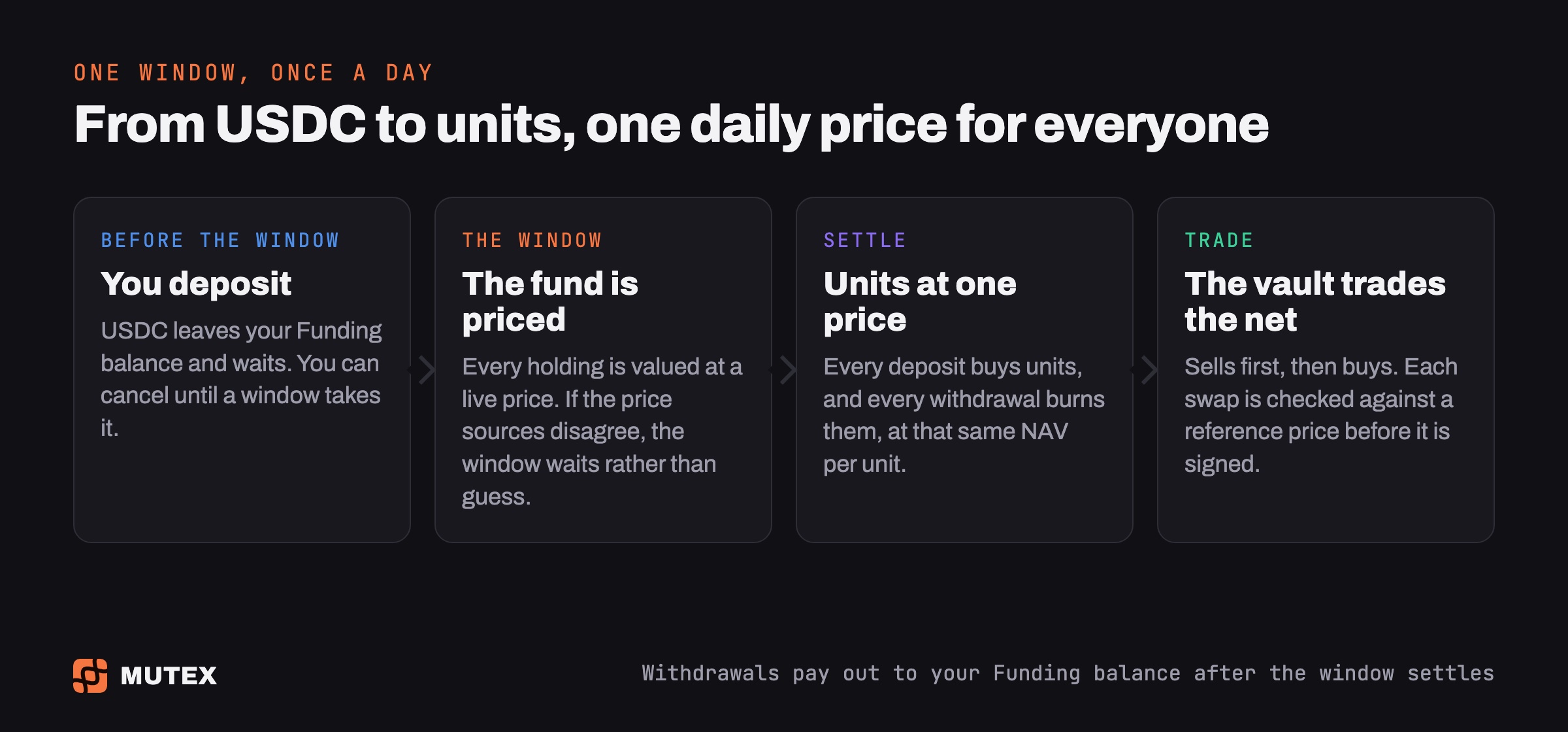
- You deposit. Pick a fund and an amount, 25 USDC or more. The USDC leaves your Funding balance and waits for the next window. Until a window takes it, you can cancel.
- The window prices the fund. Every holding is valued at a live price, and the fund’s NAV per unit is pinned. If the price sources disagree, the window does not guess: it waits, and nothing settles until they agree.
- Everyone gets the same price. Every deposit in the window buys units at that NAV, and every withdrawal sells units at it. Nobody, MUTEX included, knows the price when a request is made.
- The vault trades the net. Deposits and withdrawals are netted first, so the fund only buys or sells the difference. Every swap is checked against a reference price before it is signed, and refused if the market is out of line.
- Withdrawals pay out. You choose how many units to sell. The cash lands in your Funding balance when the window settles.
The window currently runs at 14:40 UTC. A fund that holds, or may hold, tokenized stocks or ETFs runs only while the US stock market is open, because a tokenized share trades on stale prices while the exchange is shut. A crypto-only fund runs every calendar day.
What it costs
Every fee is on the fund’s page and in the deposit panel before you confirm:
- Mutex fee: 0.05% a year currently, on every fund, for running the windows, the trades and the rebalances.
- Index fee: set by whoever made the fund, up to 2% a year currently, shown on its page and never changed after. The house funds charge 0.05% a year currently.
- Network fee: a flat 1 USDC on each deposit and each withdrawal currently, for the blockchain transactions.
The yearly fees are taken one twelfth a month by minting new units, so they never show up as a charge on your balance. Rebalancing has no fee of its own: the spread and slippage of a fund’s swaps show up in its price per unit.
The fine print
An index spreads risk; it does not remove it. A fund’s value follows the assets it holds, and stocks and crypto can fall a long way, all at once. You do not know your price when you click, so a day’s move before the window is yours. A fund holding tokenized stocks can wait days over a weekend or a holiday. Backtests are simulated and leave out assets that no longer exist, so they are not a promise of returns. If something is wrong with a fund’s vault, it can be halted: it takes no deposits or withdrawals until it is fixed, and your units stay as they are.
Get started
Browse the funds in the MUTEX app, read each rule and backtest, and deposit from your Funding balance. Or open the index builder, try a rule on your own theme and watch its backtest take shape, before you put in a dollar. The rules for every fund, the house list, the fees and the builder are on the index funds page. If you would rather hold a basket at weights you set yourself and trade it continuously, the Rebalance bot does that on your own account.